Sunday, July 29, 2012

Cat fight waking the neighbours?


Rock group case could put the cat amongst the pigeons in attitudes towards Russia's authorities

It’s not new for people to sound alarm bells about Russia. Commentators and activists have tried to raise awareness, about security threats to neighbouring states, espionage, human rights abuses etc. for a very long time. What is new is to hear the likes of Sting and Red Hot Chilli Peppers speaking out about rule of law in Russia.

The case of Pussy Riot, the rock group arrested for a lewd impromptu performance in a Moscow cathedral is very helpfully waking people up to how repressive things are getting in the former Soviet space, and how rule of law works as a tool of the regime rather than as a keeper of the peace. This, against a background of Russian support for Syria’s President Assad, must surely be finally helping to win over some of the more naive to the argument that we should be genuinely worried about the path the EU’s eastern neighbour is taking.

I hesitate to throw myself 100% behind Pussy Riot’s cause because I do think that what they did was offensive. The sanction of 7 years in prison being suggested is clearly obscenely disproportionate. It should all have been dealt with by now. A fine or a week in jail would have sufficed. However, from a christian position of conscience, I can’t quite bring myself to outright support them if it implies that they did nothing wrong, whereas for a good majority of those supporting them, I would suspect that they think that behaving that way in a church is just fine.

Coming back to Ukraine, what are the implications of a severe sentence for Pussy Riot on Ukraine’s own Femen, whose protests have so far been dealt with more sensibly by the Ukrainian authorities. Femen sprang up during the more liberal 2005-10 Orange era and for a while had the sympathy of many liberals, highlighting some very serious issues. And as for the tactics of baring their breasts, just how do you get the attention of people in such a male chauvinist society?

More recently Femen have discredited themselves with some ill-chosen targets (such as the Vatican) and some tenuous causes. One of their most recent protests in Kiev’s Euro 2012 fan zone was greeted more with glee by beered up foreign football fans than anything else. If they do wish to continue though, they should bear in mind that the current government’s instruction manual just says COPY RUSSIA in big letters on the first page, so 7 years for Pussy Riot could well send out a message to them too.

Russia could calm a lot of people down by letting Pussy Riot go free, but in the wider context, dare I suggest that a rock band in prison might be the symbolism that’s needed to redefine people’s attitudes towards what’s really going on in Russia? The authorities there have quite a propensity to shoot themselves in the foot, so it would be no surprise if they did so again.

Thursday, July 05, 2012

More games


Just 3 days on from the epic final game, Ukraine’s Euro 2012 grace period appears to be over

President Yanukovych had been due to give a speech today extolling the virtues of Ukraine’s successful (broadly speaking) co-hosting of Euro 2012. The strategy was always to cash in on the feel good factor towards October’s parliamentary elections. On today’s evidence, that feel good factor will have long evaporated before then (don’t forget how quickly euphoria over the Orange Revolution died). The Party of Regions’ case for using Euro 2012 as a prop is not airtight. For a start, one can be pretty certain that the tournament would never have come this way were it not for the Orange Revolution and its pseudo-democrats. As a quick thought experiment, could one have imagined Poland offering to co-host the tournament with Belarus? Clearly not. The President has hinted at a snap election. Snap might very well be the word.

The President’s speech was pulled as the final reading of the bill on Russianal..., ahem, ‘regional’ languages got rather messy. Accusations of creative parliamentarianism in the timing of the vote sound plausible. Then Lytvyn, the Speaker, has chosen to resign (does he think his career will be over if he signs it?). Things got messy on the streets too. Tear gas was used and Klitschko is finding that the physical risks of being a politician in Ukraine are not so different from his old job. He’s spoken out against the new law, and that’s interesting when one considers that he is Russian-speaking and has been broadly pragmatic on some pro-Russian issues, such the Black Sea Fleet. There are calls on the President to veto the law and I’m not so sure he won’t. The law’s legitimacy is weak, but then all the laws passed since the advent of the ‘tushki’ are dubious and open to challenge. It is forgotten that the Orange parties are still the rightful owners of the list mandates until the next elections. It was the EU’s costly mistake not to haul up Yanukovych early on on that point.

If the law does finally get passed, the implications are uncertain. It’s possible that not much will change. The Russian language issue really only exists for two groups of people. For one group, it is those who were Russian language-educated during the Soviet period, and the older you get, the harder it is to learn new tricks. I’m all for some sensible pragmatism here. If someone is over the age of, say, 40, and genuinely struggles with Ukrainian, then cut them a little slack. Young people simply don’t have the same problems with Ukrainian, as they have grown up with both, so changing the law at this stage is like putting the limitations of the old on the young. When you look at the average age of Ukraine’s leading politicians, you can see why the limitations of the old might prevail here. The other group is that which feels that on principle, they should advocate Russian and oppose Ukrainian, because of identity, or just prejudice. From meeting a broad section of Ukrainian society, I have met such attitudes surprisingly rarely. One friend who lived in Donetsk for some time said that, whilst some had a negative attitude towards Ukrainian, many others said ‘it’s great that we have a national language, I just wish I could speak it’.

One other issue that’s been sidelined in the more serious mêlée is whether we really will see the other regional languages given full status. From living in Hungary for 3 years, I know that people there will be watching eagerly to see whether this raises the status of Hungarian in Zakarpattya. Will people in Uzhgorod really be able to have medical treatment, write university essays or even speak in the Verkhovna Rada in Hungarian? If they could, the situation would compare favourably with the treatment of the Hungarian minorities in other neighbouring countries, but it sounds implausible to me. And if they could, can Ukraine afford this?

I would favour a solution where perhaps Donetsk and Lugansk oblasts, and possibly one or two others, could have Russian as official regional languages, with the requirement that Ukrainian language and literature be taught. Then there is Crimea, where I would advocate the promotion of two languages, but these being Russian and Tatar. I would like to see Tatar place names written on road signs and the like. If the graffiti cans then come out, so be it. Intolerance would be there for all to see and, hopefully, over time, questions asked. Another option would be to raise the minority threshold to 20%, that referred to in the European Charter on Minority Languages. The 10% threshold is what threatens to make Russian a de facto second state language.   

Whatever happens, it’s worth remembering that, even if we conservatively say that Ukrainian has maybe 25 million speakers, that’s not small beer, and more speakers than that of many other languages in Europe. Ukrainian will always suffer from being linguistically close to a dominant language, like Scots to English or Catalan to Spanish. Ireland has an official language that only a tiny minority actually speak. Ukrainian has its work cut out, but it’s never best to rely on the government for such things. It’s up to people themselves to keep speaking it (speak it more in public!) and keep it alive. Use it or lose it!

Friday, June 15, 2012

Ukraine’s options continue to narrow

Euro 2012 may be keeping Ukraine out of international isolation for a month, but were it not for the championship, Ukraine would be right on the fast track to obscurity. Almost every supra-national body is becoming wary of its dealings with Ukraine, and Ukraine’s threat of turning to Russia may be increasingly tolerated in those circles, whilst in such a situation Moscow will drive the hardest bargain it can with Kiev.

The European Parliament’s most recent resolution on Ukraine (although the EP does not have competence, in the technical sense, on foreign policy) gives the general flavour of the way things are going: “Ukraine’s human rights record, its respect for civil liberties and fundamental freedoms and for the rule of law, with the incorporation of fair, impartial and independent legal processes, and its focus on internal reform are prerequisites for the further development of relations between the EU and Ukraine.” Or read another way, Ukraine’s ever-increasing lack of it more or less puts a hold on further European integration, whether the President declares a ‘pause’ or not. Ukraine’s conduct has actually forced the EU to redefine the whole Association Agreement dialogue. From being a largely technical process the proceedings have, almost by necessity, now taken on an implicitly political character.

There is still some tinkering going on to try to save face. The phrase ‘political detainees’ was softened to ‘prisoners sentenced on politically motivated grounds’, owing to Ukraine's request to the Council of Europe to define ‘political detainee’, which it declined to do. However, for all the technicalities, Tymoshenko is clearly the deal breaker (not necessarily rightly), and on its chief demand it looks as if there will be no joy for the west. The ‘anachronistic’ laws that put her there have not been repealed and the queue of new charges may be a bid to prevent even the European Court of Human Rights giving her a clean slate. Personally I’m not so sure that her staying in prison is simply the personal vendetta of other politicians, but rather a pragmatic move, seeing as her time in office allegedly lost certain individuals large sums of money. A freed Tymoshenko back in office might block revenue streams to certain individuals, and that’s money, after all.  

With the EU relationship bringing only bad cheer, Ukraine hoped the NATO Summit in Chicago would be an avenue for more positive developments but, in the end, most of the delegations refused to have meetings with Yanukovych. Of those that did, Poland and Romania chastised Ukraine over the political prisoners issue, leaving only Afghanistan, where the focus was simply on reconstruction projects that Ukraine could gain there. NATO also joins the EU’s chorus, in the summit declaration, over ‘selective applications of justice’. Meanwhile, there were signs that Georgia, for example, is slowly inching towards membership, even despite its territorial issues. NATO will still co-operate with Ukraine where it needs to, for example with the use of Ukraine’s helicopters, but from the ill-deserved positive publicity given Yanukovych for Ukraine’s nuclear disarmament (a free gift from Obama), Ukraine’s role this time is more as an extra than as a star.

So with the EU relationship crumbling, the IMF out of the picture, and NATO getting lukewarm, we are left with the opaque and baffling dealings between Ukraine and Russia. Following the Russian ban on Ukrainian cheese and the tit-for-tat (sort of) ban on Belarusian dairy products (vive la Customs Union!) things seem to be settling down there. Of course, the main discussion is one of gas.

Firstly, there are the contracts that Tymoshenko supposedly ‘illegally’ signed, but which Ukraine doesn’t seem to be able to get itself out of, with not even initial signs of a Russian shift in position. The Black Sea Fleet deal of 2010 was seemingly for nothing. Yet, with the lack of other options, Ukraine is still trying to cut a deal with Russia.

The old chestnut of the tri-partite ownership of Ukraine’s gas pipelines is being trotted out once again. This, in the end, would also most likely yield nothing in return. The whole concept of the ‘EU share’ is nonsense to start with. Pipelines are not operated in the EU as geopolitical concerns. Countries do not own pipelines and there is certainly no precedent for supra-national ownership of gas pipelines, so what we are talking about is two thirds ownership by the Russian and Ukrainian state, and one third ownership from a company or consortium from the EU, and that invites most likely a deal with Gazprom.

That leads onto the second drawback, which is that even if Ukraine’s drive for shale gas extraction is successful (and awarding concessions in a relatively straightforward way to Shell and Chevron was a good start), Ukraine may find itself unable to realise the potential of shale gas if there are restrictions on its distribution because of unhelpful pipeline operators owing to an ill-conceived, short-termist pipeline deal. To add to this, experts say Russia is unlikely to even pay the proper market price for the GTS. Ukraine fears the loss of transit traffic, but because of a European Commission stipulation that no more than 50% of the gas through Nord Stream can be Gazprom’s, Gazprom will still need Ukraine’s gas transit for the time being.

There are also various permutations that are largely unforeseeable, and here is mere speculation. If Russia can in future put most of its gas through Nord Stream and South Stream, and if Ukraine is by then pumping out shale gas, won’t it then be just a hindrance to have Russian involvement in Ukraine’s GTS. As an aside, what will be the effect of shale gas extraction being successful. One fear is that it might in fact all be exported, and the profits used in exactly the same way as Gazprom’s are, to support a ‘Putin-lite’ in Ukraine. After all, the lack of imagination of Ukraine’s rulers invariably leads them to look to Russia for inspiration.

As one commentator wrote recently, Ukraine perhaps overestimates its geopolitical importance. When push comes to shove, the west already has plenty of friends on the Black Sea. Russia’s interest is as chauvinistic as it is strategic (surely, in theory, a new modern naval port on Russia’s own Black Sea coast would be far more efficient and pertinent to Russian national security than maintaining their ‘museum’ in Sevastopol, but when a feeble pretension to a naval port in Syria is enough to sanction the deaths of thousands of people, we know that common sense is not at work here).

Ukraine’s problem will be that, if the elections this October fail the democratic litmus test, it matters less and less what foreign policy direction Ukraine proclaims. If the standards of democracy, rule of law, and management of the economy converge ever more closely with those of the member states of the Customs Union, then that may be the country’s default destination.

Monday, June 04, 2012

Kiev or Kyiv: What name is 'in'?

For those championing the spelling 'Kyiv', Euro 2012 will have a mixed outcome. --- For some time there has been a big campaign amongst Ukrainian patriots and certain members of the diaspora to adopt the spelling 'Kyiv' as the English language name of Ukraine's capital. Now that Euro 2012 is finally upon us, this is perhaps the acid test of their efforts. Looking at the BBC venue guide for Euro 2012 above, it looks as if not everybody has been convinced. Doubtless there has been a flood of letters pointing this out, but no change has been made. To me, the map is correct. The names of both capital cities are spelled as they have been in English for a very long time. For the provincial cities however, the local names have been used. Nobody is trotting out 'Danzig' for Gdańsk or 'Breslau' for Wrocław. None of the many names that Lviv has previously been known by appear(Lvov, Lwów, Lemberg or even Leopolis) and Kharkiv takes its Ukrainian spelling rather than the Russian one Kharkov. Many publications have adopted the Kyiv spelling, most likely after activists' persistence, but some have resisted. The Financial Times, the New York Times and The Economist, for example, have retained the Kiev spelling. For Euro 2012, UEFA is going with the Kyiv spelling, whilst the BBC coverage is using Kiev. --- Spelling Kiev as 'Kyiv' is confusing 2 things-the correct transliteration of Ukrainian into the Roman alphabet, and what the correct name of the city should be in English. The Ukrainian name Київ (Kyiv) contains two sounds that don't even exist in the English language, and I can testify that correct pronunciation of Ky-iv takes quite a bit of practice for native speakers. Visiting fans to Euro 2012 are unlikely to get the hang of it during their short visit. It is common for English to use its own names for many of Europe's major cities. Kiev is a much more natural pronunciation for English speakers. If we followed the same logic elsewhere, Athens should be Afina, Moscow should be Moskva (or maybe even 'Maskva'), Belgrade Beograd etc., not to mention saying 'Paree' instead of Paris, and adopting München instead of Munich and Firenze instead of Florence. The demand for the Kyiv spelling is therefore not a consistent one. Why only Kyiv? Why not all these other places too? It has been Kiev in English for a very long time. Indeed, Chicken Kiev (to which this blog takes a bow) is a world-renowned dish and proof of how well-established the Kiev name is. The fact that a city is well-established and well-known abroad is surely no source of shame. --- The other inconsistency is that this effort seems to target only English. A quick google search for 'Kyiw' (the logical German variant) yielded no results, and French seems to have several versions, of which Kiev is the most prevalent. Ukrainian itself also doesn't have its own house in order here. Beijing is still Пекін (Pekin) in Ukrainian. Париж (Paryzh) would need to be ditched in favour of Пари. Most Ukrainian people make little effort to pronounce London as native speakers do (more 'on' than 'un'), and nor should they. If they are speaking their own language who am I to dictate? English speakers will always pronounce it 'Ki-ev' even if it's spelt Kyiv, and the exceptions will be those such as diplomatic staff who are coached on getting it right. --- My aim here is not to bash the Ukrainian language. In fact I very much support it, speak it here in Kiev (although not particularly well), and think that it should remain the only national language of Ukraine. Even if, at a very conservative estimate, only 20 million or so people speak Ukrainian as their first language, in European terms that's not small beer. That's more than speak, for example, Hungarian, Romanian, Bulgarian, or many of the official languages of the European Union. It's also a beautiful and poetic language that I have come to love. The push for 'Kyiv' in English though is a curious fetish. With the Ukrainian language under attack at home under various government policies and proposals, the leader of the opposition in prison, numerous police, human rights abuses and cases of corruption to highlight, aren't there more productive ways of helping Ukraine than writing ill-reasoned letters to the Sunday Times or whatever because a journalist dared write 'Kiev'. Talk about fiddling while Rome burns! --- The crux of the matter for some is the similarity between the English 'Kiev' and the Russian 'Киев'. However, that is rather a suspect motive for trying to change it. Calling the city Kiev in English is not pro-Russian and it's not anti-Ukrainian, it's just correct English. For comparison, calling Dublin by its English name rather than the Gaelic Baile Átha Cliath is not considered anti-Irish. People should not be labeled anti-Ukrainian just because they want to use English correctly. It has been cited that the Ukrainian Ministry of Foreign Affairs has asked for it to be spelled Kyiv, so that should be that, but I don't accept that. The Ukrainian government's call to adopt the spelling 'Kyiv' in English was misguided. In my experience most Ukrainian politicians and civil servants don't even speak English, and are therefore ill-placed to make a judgement on English language usage. The MFA also insists on clumsy translations, so that every official Ukrainian state body has to be the xyz 'of Ukraine', so the Ukrainian MFA is, for example, 'The Ministry of Foreign Affairs OF Ukraine', and similar translations appear everywhere. The constant 'OF of OF' is incongruous in the English language. Ukraine has 'asked for' Kyiv, but in my view it's a somewhat curious thing to ask for. --- In the end if you argue that to protect your own language you need to dictate to native speakers of another language how they should use theirs, I think you're on pretty shaky ground. English is international, but its native speakers are still entitled to use the language as they so wish. One more cheeky point I could make is that, when one learns Ukrainian, there is an interesting twist to this tale in the Ukrainian case endings. Kiev is Kyiv in Ukrainian but 'in Kiev' is in fact 'в Києві' ('v Kievi') and 'in Lviv' becomes 'у Львові' (u Lvovi), so having gone to all this trouble to tell speakers of another language how to change their spelling, Ukrainian grammar, after all that, then changes it back! It looks for now as if the two variations will persist, as with Basel and Basle. But still, Ukraine has not yet perished and neither, for the time being, has Kiev. :)

Wednesday, May 30, 2012

Cameron’s Dangerous Game Could Have Dire Consequences in the East

The ‘continuous delay’ of a European Court of Human Rights ruling will not go unnoticed by Eastern Europe’s authoritarian governments

On the face of it, David Cameron’s stance on the European Court of Human Rights’ ruling which would have allowed prisoners in the UK to vote seems the right one. He has upheld the will of the democratically-elected House of Commons against the whim of an intrusive ‘foreign court’.

It is not just that the UK is opting out of ECHR decisions, but it is how it is doing it. First London pursued the avenue of trying to make the court’s rulings ‘advisory’ to those of national courts, but failed to make the inroads it would have liked to have done in the Brighton Declaration. Now the UK is taking a different tack. The ECHR has given the UK 6 months to fall into line, but UK ministers have suggested they will just indefinitely put off the court’s ruling and leave it hanging in the air. They would simply submit annual 'progress reports',so kicking its implementation into the long grass for the foreseeable future. Such ingenuity is the kind the Kremlin would be proud of.

Now, on the specific issue in question many would sympathise with the UK government’s position. One could reasonably argue, in a moral sense, that the individual who has taken the rights of others should lose rights of their own, and many clearly think so, including the Shadow Chancellor. I happen to think that excluding these people further from society probably does little to help rehabilitate them, but if people who’ve done nasty things can’t vote I wouldn’t lose much sleep over it.

What bothers me, from a Europe wide perspective, is how this mechanism might be used elsewhere. Certain members of the Council of Europe already drag their feet when it comes to Strasbourg’s rulings, and consistently fail to bring their national standards into line with those of the Council of Europe. But at the moment, at least we can say with some justification that these countries are failing to achieve European standards, and to satisfy the conditions that they entered into when they joined the Council of Europe. Now however, they might just ‘indefinitely postpone’ judgements against them, arguing quite reasonably that there should not be one rule for them and different rules for others.

The UK on the other hand needs to look carefully at the path it has taken. It seems reasonable to lobby about what cases and issues might be excluded from Strasbourg’s reach. The backlog of cases at the ECHR is well documented, and perhaps, as some have suggested, there are issues of conscience which might reasonably be put firmly in the remit of national governments. What I would take issue with is the Prime Minister’s emotive language about the ECHR being a ‘foreign court’.

Nobody forces the UK to be a member of the Council of Europe. Belarus after all shows how you can manage without such foreign meddling. The metro bombers who were sentenced to death, and their families informed the following day, didn’t have to hang around for Strasbourg’s dithering. I’m not suggesting the UK wants to follow Belarus, but listening to some people you have to wonder. On the back of various cases, such as the infamous ‘pet cat’ case, human rights has become a dirty word in Britain. Sections of the press have become remarkably successful in pinning the blame for these things on these so-called ‘foreign’ organisations. However, I am reminded of Radek Sikorski’s succinct take on UK-EU relations in his famous speech of last November: “...please start explaining to your people that European decisions are not Brussels's diktats but results of agreements in which you freely participate.” Perhaps the UK needs to rethink that participation, if it’s such an issue for them. With UKIP still noisy, and even calls to pull Britain out of the Eurovision Song Contest, perhaps this is a discussion Britons urgently need to be having.

However, staying within but undermining an institution such as the ECHR, the last chance saloon for many in Europe’s east, seems irresponsible. The consequences of bending the rules will be seen far beyond Britain’s prisons.

Saturday, May 19, 2012

UK press show that racism works both ways

British press reports about Ukraine are well wide of the mark, and in some cases just plain offensive --- Before even getting onto Euro 2012, the British press is letting itself down badly over Ukraine. For many years that country was ignored by most of the British papers (with the notable exception of the FT) and tended to spew out occasional clichéd pieces on the failure of the Orange Revolution. The Daily Mail has bought into the Tymoshenko story as one of their 'human interest' stories, to the extent even of reporting lovingly on the white tiger from her presidential election campaign. Back in the winter of early 2010 I distinctly remember most people being unimpressed by the ads as we slid around on ice and snow that had not been cleared (with some suggesting that funds for snow clearing might have been diverted into her election campaign). By all means highlight accusations of mistreatment in prison, but please don't start doting. --- I must say at this point that the last thing I want to do here is just indulge in straightforward 'whataboutism' of the kind peddled by Russia Today or the absurdly-named 'Pravda'. I have no truck with people who say that just because British MPs stole cat food, or even duck islands on their expenses that we're 'just as bad' as ministers in CIS countries stealing companies and mansions, or that the inadequacies of western democracies are no different to rigged elections and constitutional vandalism in the CIS. I think we could be a little more humble at times (Freedom House should not rate western democracies as a perfect '1'-the people living in those countries certainly don't feel that way) but we have a right to criticise abuses where they take place. --- It was the aforesaid (nye)Pravda that ran a story on the Luis Suárez racism row claiming that English football was 'riddled with racism', in a clear effort to deflect from the story that Roberto Carlos had again had a banana hoyed at him in a Russian league match. The fact that Suárez was banned for ten matches, and that John Terry is being hauled in front of the courts, while nothing has been done (to my knowledge) about the Carlos situation in Russia tells its own story. We know that the British media too is 'not perfect', hence the Leveson Inquiry, although some of the UK papers' most recent abuses are unlikely to arouse much concern in the isles, directed as they are towards the distant poorer half of the continent. --- Interesting though the politics is, for the tabloids it's coverage of Euro 2012 that's going to shift newspapers. Enter The Sun (and on the topical subject of boycotts, The Sun has form here), who started spewing out various negative articles on the host nations, as soon as England had managed to qualify of course. They have picked up on three apparently salient issues, those of racism, hooliganism and sex tourism. I won't say that these problems don't exist (as Ukrainian government representatives have tried to) but the reporting of them is not even sensationalist, just plain absurd. Theatrical-looking photos accompany stories about nationalist training camps for hooligans. Nobody I know here in Ukraine knows anything about it and it looks like far-fetched nonsense. I think what is more likely is that there could be isolated flare-ups due to a combination of alcohol, the language barrier, and cultural misunderstanding. Some of the shoving on the metro or aggressively bad customer service (some people here have a way of saying 'zakrita'-we're closed-which might as well be f*** off). That's the kind of thing which Ukrainians routinely live with but can flick the switch of the average Brit pretty easily. Ukrainian police can also not be relied upon. These are genuine things to be concerned about. Semi-fictional militarised hooligan firms are not. The visit of 6000 Scotland fans to Kiev in 2006 gives an idea of what to expect. There was a nasty incident in the city centre which affected some supporters. For the vast majority however, the experience of coming to Kiev was a positive one, and the locals took to their kilted visitors.
--- On another issue The Sun also offers up an equally staged-looking photo of sex workers lined up in front of Shakhtar's Donbas Arena. Now in one sense there is a very serious issue here. Ukraine does indeed have high levels of HIV and AIDS, particularly in the east and south of the country, but I don't see that the issue is any different from elsewhere. People who use sex workers anywhere are playing with fire, not only in Ukraine. Should we portray British men with revolting habits as the victims in this?
--- Then there are the Walcotts, brother and father of Theo, who have decided not to come, and a broad consensus amongst various people in the UK that this is probably sensible. Again, it doesn't make much sense to people on the ground here in Kiev. Do they think that they'll be racially-abused in the hotels and restaurants? Are Arsenal paying their players so little these days that the Walcotts can't afford taxis and will need to take the metro late at night? It's true that Ukraine doesn't have a history of multi-culturalism, but there are plenty of countries that don't. Moscow is famous for its racism problems and neo-Nazism which includes celebrating the birthday of Hitler (the very man who ransacked their country and regarded them as 'untermenschen'), but I would still bet on a racist attack being just as likely in London, probably more likely. Kiev is a pretty safe city. --- On the issue of racism there is one more thing that needs to be said, that the very treatment of Ukraine and its stereotypes in the British press illustrates a widespread racism against Eastern Europeans in Britain which is only just beginning to be tackled. Would the racist rant lady on a Croydon tram have been arrested if her rant had only been against Polish people? The Polish are given a horrendous time in the British press and on message boards and phone-ins, although they are net contributors to UK coffers, staying typically for short spells before returning to Poland with what they've saved. The 'Borat' stereotype is all over the place. I remember a contributor once on a football message board referring to Eastern European countries collectively as 'Eastbumistan'. Would he have written something like that about Africa or Asia without being censured? --- There are plenty of legitimate areas in which to go after Ukraine, whether it be the rip-off hotel prices, lack of readiness for the tournament, alleged corruption in improving the facilities or the worsening political climate in which the tournament is being held, but cheap racist shots from the British press are shameful. Theo Walcott's brother is probably right about one thing though-“some things aren’t worth risking”-judging by the performance of the England team in major tournaments, people are probably best off staying home.

Sunday, May 13, 2012

And now the news - 67 years ago there was a war

Ukrainian tv viewers take the blue pill --- A few months ago it was still noticeable that Ukrainian news programmes on major networks were continuing to cover all the major news stories, in contrast to Russia where major events such as mass protests and terrorist attacks are completely absent from the country's tv screens. There was perhaps pro-government bias in evidence, but not the complete absence of these events from the news. That has now all changed. More recently the main news programme on Ukraine's most popular television channel, Russian language channel INTER, seems totally devoid of serious news. --- In the most absurd example, the Easter Day broadcast contained a feature lasting a good 15 minutes or so about Easter Island, solely for the fact that it's named after Easter. It was very nice, interesting even, but by no remote stretch of the imagination could it be considered news. --- It was of course the 9th May last Wednesday, Victory Day, and as expected, commemorations have continued to be higher profile, and distinctly re-Sovietised from the more low key commemorations of previous times. It seems to be having the 'desired effect', with plenty of people this year sporting the Dundee United coloured ribbons on bags and cars. On the 9th May itself it's perhaps understandable, but 'Great Patriotic War' related items have fronted the news every day for the past week. It can hardly be called news. --- One worries that the powers in control of the media would like Ukrainians to take the blue pill, to disengage their minds from the serious issues facing the country. After all, many of these news items are interesting, and seem harmless enough, and bad news can be very fatiguing in a country that has plenty of it. To me, however, this is very saddening. People here are already isolated enough. --- Today the issues relating to Tymoshenko's hospital treatment eventually made it on around 16 minutes into the broadcast, and there was even a statement from the opposition. Protests against Putin in Russia were also featured. Perhaps there is still hope.

Tuesday, May 01, 2012

Merkel boycotts Ukraine? Business as usual.

Germany has been boycotting Ukraine's interests for some time. --- I realise this assertion might grate with some poeple, particularly as I know and work with Germans here in Kiev who are working hard on the various civil society initiatives that Germany generously funds, but I can't get excited about Chancellor Merkel's threat to boycott the European Championships. It seems somewhat pious when one considers that Germany has not made Ukraine or Ukrainians' lives very easy in the past couple of years. Germany sees itself in all things as a benign actor, but the reality is rather different. --- Go back to 2008, when Germany made it absolutely clear that its relations with Russia were more important than the security of those countries sandwiched between them. For Ukraine and Georgia, that meant an effective veto of Russia, a non-member, over their bid for NATO MAPs. Go back further, and it was her predecessor Schröder who signed up to Nord Stream, a game-changer in the energy security geopolitics of the region which greatly undermines the position of Ukraine. German EU commissioner Günter Verheugen quipped that the idea of Ukraine joining the EU was as absurd as that of Mexico joining the United States. More recently, German police arrested and jailed a group of Ukrainian tourists on a two day visit to Germany on their one year Polish Schengen visas. They were released without apology. Apparently, quite absurdly, they should have gone and cancelled their one year visas and got two day tourist visas. The Schengen system isn't working, but it is Germany's job to work that out, rather than to label all Ukrainians as undesirables. What kind of message does that send? --- The boycott threat is of course not made in such a wide context, but is part of the current political game. Some kind of a statement does need to be made. It also recognises that there is indeed something deeply unpalatable about Holland v Germany being played, and beers being guzzled on Kharkiv's Ploshcha Svobody, just a stone's throw from Europe's most high profile political prisoner (the authorities have already moved her once, and may conceivably do so again in a feeble attempt to minimise such embarrassment). Perhaps Merkel is doing the right thing, but against the wrong things which preceded it it looks less impressive. Germany should in fact, albeit indirectly, accept some responsibility for what has happened here since 2010. --- As one leading commentator said a couple of years back, it would have meant an awful lot if Chancellor Merkel had come to Kiev and made a speech in support of Ukraine's European ambitions. Don't forget how narrowly Tymoshenko lost the Presidential election. German endorsement of a European and Euro-Atlantic choice for Ukraine might well have been enough to swing the election for her, but instead it was held against a background of resignation, that Europe didn't want Ukraine and rapprochement with Russia was paramount. Merkel was not there for her then.

Thursday, February 23, 2012

Ukraine’s faltering role model?

Could the true face of Putinisation in Ukraine be yet to appear, just when the concept appears to be on borrowed time?

Putinizatsiya is a popular label for what has happened to Ukraine over the last two years. Some call the system a modern feudalist system, but it is perhaps more accurate to describe it as clan-based. What most people can readily observe could be called rather Donbasisation, an enlargement in the scope of what took place in Donbas in the 1990’s, in terms of who from various friends and close relatives controls various businesses (and by what methods). Ukraine could as a result be lumbered with a cronyist economic environment that, without the element of meritocracy, will be doomed to lurch on inefficiently for years to come whilst the world outside continues to surge forward. It will be almost impossible to sensibly unravel should anyone in the future propose to do so.

Ukraine may not be a neo-Tsarist system as such, but the country continues to tiresomely follow Russia’s lead, for example the retrogressive education ‘reforms’, gleefully unwinding progress towards the Bologna process it entered a few years back, or the absurd commitment to follow Russia’s lead in abolishing daylight savings on the advice of ‘scientists’ (Muscovites now start work or school in the dark, a full two hours ahead of Kiev). Such backward measures can only pull Ukraine further away from the European sphere (the decision to delay the time change until after Euro 2012 is tacit acknowledgement of this).

But if the ‘new order’ really wants to go the whole hog and bring about true Putinisation, they have to take seriously that Yanukovych lacks Putin’s personal popularity. Nobody can seriously believe that the Party of Regions can stand on a United Russia-style ticket of ‘support President Yanukovych’ and attempts to plaster the President’s mug on billboards around the country have had a somewhat mixed reception. Can you really build a personality cult around Yanukovych? Stories of the President doing handstands and the like impress some people in this politically unsophisticated country, but the action man image may be difficult to cultivate.

Putin’s rise to power was never really about elections. He was appointed. So is Yanukovych less of a Putin and in fact more a Yeltsin, who will facilitate the rise of an appointed successor? As with Putin, the man himself may not be well-known currently and may not be of political stock at all. Look past Yatseniuk, Tigipko and Brezhnev-era fossils that currently occupy high office. The recent maneuverings in defence and security posts may yield the answers. Could it conceivably be, as it was in Russia, someone with security service connections? Will he also need to have real popularity? In any case Putin’s famed 'popularity' might not be as real as many assume.

The biggest stumbling block to the path to following this strategy may be events In Russia itself, where there are early signs that the wheels may finally be coming off the cart of Putinism, at least to the extent that some form of real opposition may have to be accommodated. The elections this year may well, in some way or other, be part of a shakedown in the Russian system. However, these people will not give up what they have gained easily. In Belarus for example, Lukashenka has been able to quell the hand-clapping protests against him despite many reports I’ve heard first hand that the locals no longer speak well of him.

Ukraine, even with its fair share of political apathy and debilitating pessimism, is different, even if the difference is more nuanced than substantial. It will have a shorter fuse than its CIS neighbours if faced with an undemocratic imposition. Notional support for a European future in Ukraine is still high, with countless young people still telling me philosophically that they still hope their country’s future eventually lies with Europe. And, as stated earlier, the inefficiency of the cronyist system will always leave it vulnerable to failure.

Ukraine now may become a fully authoritarian or 'unfree' regime, an imperfect but functioning democracy able to make friends, or a kind of European Venezuela, but if Putinism really is the model, and if events in Russia continue to suggest that Putinism is indeed now passé, Ukraine’s authoritarian masterplan may just need a rethink.

Thursday, December 29, 2011

Ten reasons to be optimistic for Ukraine in 2012

The words 'clutching' and 'straws' spring to mind, but here are some attempts at being optimistic for the coming year.

1. The Russian awakening

If you're trying to imitate the Putinist system in Ukraine, 2011 has not been a good year. The Arab spring has already challenged the convenient myth that the desire for democracy is simply a curious fetish of the western world. Putin's recent interviews have verged on incoherency, with their conflicting arguments and bizarre plot threads (Hilary Clinton has around 100 000 cheques to put in the post, and little chance that the money will arrive before the end of the New Year shopping rush. In any case, if all these people really are being paid by America, why pick on Clinton rather than Obama?). So with its slogan 'За честные выборы' ('for free elections'-a sensible call to rally around rather than trying to find a unified voice on all the various complex issues) the Russian awakening could get awkward for anyone wishing to push through a preferred outcome for the 2012 parliamentary elections in Ukraine. If the March presidential election in Russia gets messy, then the Ukrainian ones might all the more so. After all, for those Ukrainians who think 'if they're doing it in Russia, it must be right for Ukraine' there will surely be no choice but to follow the latest trend in Moscow.


2. The not completely unfree media

On a related point, the regression of the media in Ukraine has not yet reached that of Russia. Even though every major tv channel is owned by interests close to the Party of Regions, Ukrainian tv news still covers protests and incidents, such as the recent deaths of two Chernobyl cleanup veterans in Donetsk. It does not childishly ignore such items as Russian tv tends to do, choosing not to cover the story of the thousands massing not far from its offices in Moscow. The furore from the attempt to hush up the famous Yanukovych wreath episode (always worth re-watching) was a learning exercise for the authorities here. So Ukrainian media is more like a 'Murdoch on steroids' than the rigid tool of an authoritarian regime, and that's something at least.

3. DCFTA in a critical condition, but not dead yet

Time will tell whether Ukraine has successfully played the neo-Titoist east-west balancing game between Russia and the west or whether the country's number is finally up. The situation in Belarus, where Russia is now helping itself to the country's gas pipeline network and strategic assets, is a great warning here. The EU has, in the end, put on the table quite a reasonable free trade deal which Ukraine could do well out of, if the country can get the better of its debilitating parochialism. I agree with the view that's been expressed elsewhere that Tymoshenko shouldn't necessarily be the EU's red line (we should see what Strasbourg has to say about it first) but the 2012 parliamentary elections must be free and fair, and the general 'Donbasization' of Ukraine's business environment needs to subside. It's not yet too late to put Ukraine back on the right path and for everyone to benefit, and for various reasons 2012 may just prompt a rethink in high places. Here's hoping anyway.


4. Ukraine can't isolate itself completely in 2012

2011 was certainly a year of increasing isolation for Ukraine. Foreign businesses have been pushed out or decided to leave, business visa rates raised for foreigners, and the EU told to back off and stay out of Ukraine's affairs. Russia will also turn nasty if Ukraine's gas pipelines are not handed over, leaving Ukraine with perhaps nowhere to turn. Against this background, we can expect it to get even harder for Ukrainian nationals to get those precious visas to Europe and America. That makes Euro 2012 a potential foil to this trend of isolationism, with the attention from foreign media and visit of many thousands of those cursed foreigners, hopefully breaking down prejudices on both sides.

What would be interesting is if Ukraine somehow managed to top Group D and and then win the quarter final, setting up a semi-final in Warsaw, with the diplomatic embarrassment of thousands of Ukrainians desperately queueing up in the hope of getting their Schengen visas for the match just 4 days later. That would bring their plight of being behind the 21st century's Berlin Wall unprecedented international attention. Yet I fear the boys in yellow will not be up to that task on the field. It is however difficult to see Euro 2012 having much of a political impact on the direction of the country, any more than the Olympics in China or Eurovision in Azerbaijan! There is a much greater risk that the 'feel good' factor will be used by the Party of Regions to try and coast through the elections later in the year.


5. Strasbourg will help us to clarify the Tymoshenko situation

The European Court of Human Rights and the word 'fast' do not normally go together with its enormous backlog of cases, but we have been told that Tymoshenko's case (or cases?) will be somehow fast-tracked by Strasbourg. Some have asked whether, with a good conscience, Tymoshenko ought to be able to barge her way to the front of the queue at the expense of the cases of others but if (just if) there is a serious problem with rule of law in Ukraine, that affects the 45 million or so people that still live there. An overturning of her conviction could stop the juggernaut of what appear to be politically-motivated cases. I would be sceptical however as to whether she will be freed by any verdict of theirs. Governments elsewhere in Europe (the UK for example) would like the ECHR's rulings to be considered more as advisory than binding on the countries concerned, and that will be music to the ears of Russia and co for whom petitions to Strasbourg are the last hope of many of their abused citizens. What doesn't make sense to me is that Tymoshenko's political career has paradoxically been boosted by the whole thing, if the recent poll ratings for her party are anything to go by. As I've written before, Tymoshenko is no Aung San Suu Kyi, but the authorities may end up turning her into one.

6. The rise of UDAR

Vitali Klitschko is a busy man. He's yet to hang up his gloves and is due to defend his title once again in Germany in the new year, but for many of us it's his political career that is being watched closely. Klitschko brings a number of positives to the table. He's personally very popular in Ukraine. He's Russian-speaking, so embracing, by some estimates, a good two thirds of the country, linguistically-speaking. He understands the west, having been based in Germany for many years. He is almost the only public figure in Ukrainian politics who hasn't worked his way up by corruption, bootlicking, contract killings and goodness knows what. And he's a pragmatist-the Russian Black Sea fleet can stay in Sevastopol, but not at the expense of Ukrainian democracy. That ability to break down mental obstacles is essential for Ukraine to progress. He needs to overcome a great deal of public scepticism to become a real challenger, but much will depend, as he should know as a sportsman, on who he puts in his team. The marketing campaign that lead Yatseniuk to crash and burn should be a lesson there. But if the likes of Arnold Schwarzenegger can make it as a serious politician, there's no reason why Klitschko can't (and he can hardly be worse than some of the dross we end up with).

7. Southern vector

A counterweight to Ukraine's east-west tussle may be for the country to look south. In 2011 Ukraine and Israel began a visa free regime and Ukraine is now discussing a similar deal with Turkey. Turkey in particular is becoming a major player in the business environment here, in areas such as retail and telecommunications. Alongside Polish goods, Turkish goods are also now ubiquitous in Ukraine's shops. Turkey has some important similarities to Ukraine (both are large countries whose accession ambitions worry the old core countries of the EU) and it makes sense for both to develop deeper trade relations. The south may be just what Ukraine needs to avoid being captive to east or west.

8. Ukraine increases its cultural profile

This observation may be right or wrong, but I see Ukraine beginning to enjoy a greater flourishing of its artistic culture. It was great to see recently the Daily Mail (I'm not a reader) cover the work of Oleg Shuplyak, and the growing Kiev arts complex Mistetskiy Arsenal featured on Euronews. A country like Ukraine needs these outlets of cultural expression to find its modern day identity, and I see it starting to happen.

9. Ukraine doesn't forget

One of the great achievements of recent years has been the growing recognition of the Holodomor, a large scale human catastrophe that has been ignored in the past at least as much as others such as the Armenian Genocide. This year those of all political colours gracefully commemorated the occasion and it would now be politically unacceptable for those in power not to do so. The argument about whether it was specifically a genocide against the Ukrainian people will continue, but society has reached an encouraging consensus on the issue (I would argue that it was only part of the genocide, events such as the so-called 'Розстріляного відродження', perhaps translatable as the 'aborted renaissance' of Ukrainian culture, completing the picture).


10. (Some) Improved infrastructure

Again Euro 2012-related, there will definitely be some appreciable improvements in many things for a country that generally takes only baby steps. New airport terminals won't completely make up for the hassle of getting in and out of Ukraine but they will be very welcome. Kiev will see some improvements, such as as to the previous squalid medieval state of Andryivsky Uzviz (my opinion anyway-it was in a terrible state). New (South!) Korean-built trains will be quite a culture shock on Ukraine's railways (and are a much more sensible solution than the extravagantly expensive Sapsan trains Russia bought from the Germans, most likely as a pat on the back for letting them build Nord Stream). Six Ukrainian football teams now play in Premiership-standard stadiums rather than the crumbling concrete bowls they used to play in. Alas the construction of hundreds of miles of motorway that Yushchenko foolishly promised UEFA never materialised. The hot water will still get cut off every other week and most Ukrainians will see next to zero difference to their lives from these prestige projects, but they are a step in the right direction all the same.

The challenge for Ukraine is to put in place a system that really utilizes these improvements. Ukraine needs tourist information offices in its cities and an open skies agreement with the EU to allow more budget airlines in. What I fear however is Ukraine closing ranks after the championship. The authorities have already stated their intention to bring back the restrictions on foreign nationals changing currency that caused such havoc this autumn. It wouldn't surprise me if the visa regime for foreigners traveling to Ukraine was quietly reinstated later in the year. The types of business that benefit from tourism are generally small businesses, and seeing as the authorities have shown themselves to be anti-small business, such development may not be a priority for the government. The disconnect between expensive advertising campaigns and the arduous experience of actually coming here may continue to exist for a long time to come.


After two years of almost constant bad news, I really hope 2012 will be a good year. God bless Ukraine. Happy New Year!

Tuesday, November 22, 2011

День свободи!

Freedom Day?

This was Maidan (Independence Square) on the 7th anniversary of the start of the Orange Revolution. Nice to see so many police wanting to come and join in the commemoration...

Wednesday, October 26, 2011

Endgame: Is the Ukrainian government's Euro-circus coming to an end?

Whilst the EU dropped the ball during Yushchenko's Presidency, is the present government just trying to play Brussels? If so, the results are increasingly farcical.

The Ukrainian President's recent trip to Cuba, against the background of the cancellation of an invitation from Brussels, could almost be taken as a marker of the country's fast track route to pariah status. Now even the Party of Regions' 'friends' in the Socialist grouping of the European Parliament are distancing themselves from the regime by backing a tough-sounding resolution on Ukraine due to be delivered in Strasbourg tomorrow. It's starting to look as if the European path was never Yanukovych's objective, or at least that they were never prepared to make any sacrifices in terms of their hold on power to achieve it. In conversations with government figures the mention of the EU-Ukraine free trade deal seems to get more of a philosophical sigh than a reaction of even qualified enthusiasm. It's also starting to look as if the EU is losing patience with what looks ever more like a circus that has little to do with the democratic gains the country made under the previous presidential administration. The EU must now be very wary of signing itself into an agreement with a regime which looks so eager to wreck its European credentials. Why should the EU allow itself to be used as a bargaining chip for Ukrainian oligarchs to haggle with Russia for cheaper gas for their cash cow steel and chemicals industries? Ukraine looks like it's becoming a feudalist state at breakneck speed.

There is no doubt that the EU's decision not to step in during the early years of Yushchenko's presidency with a clear path to the EU accession process will go down as a pivotal point in the region's history. We would undoubtedly be in a different position today had they done so. It was deemed necessary in the 80's to rescue Spain and Portugal from backsliding after their democratic revolutions and to rescue Greece from the Soviet bloc (despite the clear present evidence of their unreadiness for European integration, it was probably still the right decision). It was also the right decision to grant the former Yugoslav countries a distant but clear future direction. Understanding in society of European geopolitics is low at the best of times (just look at the UK!), and in somewhere like Ukraine particularly low. The Ukrainian public needed a clear and unambiguous signal that their eventual future lies with Europe, but in the end, the climate of cynicism in 2010 was enough to open the door to the Party of Regions who, it certainly seems, were only playing by democratic rules while it suited them. Just as with the Mediterranean and Balkan examples, as experts claim, there may be an enormous cost to the west from not taking in Ukraine, not to mention Moldova etc. from having a 'European Mexico' on the EU's doorstep, a disfunctional source of criminality and immigration.

But whilst the EU was to blame 5 years ago, the isolationism of 2011 is all of Ukraine's own making. The direction that Ukraine is going in might be better suited to joining the African Union than the European Union, and a glance at many of the indicators on corruption, business environment, rule of law and democracy simply confirm this.

Monday, October 24, 2011

Shades of Blue: Is there a European alternative to the Brussels project?


The post is from October, but the issue looks increasingly relevant.

As the EU struggles with its own well-documented problems, the UK has tied itself in knots by choosing today to debate and vote on the idea of a referendum on EU membership which is unlikely to happen after all three major parties put a three-line whip on the issue to vote down the proposal, which was triggered by the same pesky government e-petition website that threatened to throw open the debate on capital punishment.

British Eurosceptics are not a homogeneous group. There are the rabid 'bent banana' Eurosceptics who ignore the geographical reality of where our island sits, and for whom there is no distinction between EU migrant workers and illegal immigrants from elsewhere in the world. There are still some with delusions about the UK's potential global role, or farcical ideas that Americans or Australians would be 'delighted' to open up to preferential economic agreements with the UK. There is the frequently-coined argument that when Britain voted in the 1970's it voted to join an economic union, not a political one, but a look at the founding treaties of the EU makes clear that it was all along a politically-coloured project. Then there are quite reasonable arguments made about the democratic deficit in the EU's institutions. There is also the technical constitutional argument, which relatively few mention but which holds some water, about the incompatibility of the EU's system with the British system, that the British constitutional principle that 'no parliament can bind its successor' is broken by the signing of European treaties.

The main argument being given against the EU referendum seems to be 'now is not the time', which means that the issue in the long term is not likely to go away. Many people will continue to support Britain's withdrawal, saying things like 'look at Norway'. A Norwegian local politician I met a couple of years back however lamented her country's unwillingness to join the EU, saying that Norway has to implement 95% of EU legislation, with a 0% say about what goes into it. Very few who truly understand the issues think that Britain can simply have no form of economic integration with the EU. If Britain, for example, was to leave the EU, but desire to continue to participate in the single market, it would have to accept something similar to the EEA deal. Switzerland, on the other hand, has a series of bilateral opt-ins and opt-outs of EU policies, but on many issues it is captive to the regime that surrounds it.

Britain, Norway, and Switzerland are not alone in feeling that their deals with Brussels are in some way unsatisfactory. Across Europe, on the eastern frontier, we have Turkey, the candidate country which may never join, which so far has only a customs agreement with the EU which is of limited value. Then there is Ukraine, which, whilst doing its best to shoot itself in the foot, has not yet formally abandoned its deep free trade area talks with the EU. Georgia and Moldova are likely to agree similar free trade deals with Europe, and the DCFTA model may be what Turkey eventually has to settle for, if it doesn't decide that a sub-optimal relationship with Europe does not outweigh the benefits of a multi-vector trade policy, given its geographical position and robust pre-crisis economic growth. In Ukraine's case, the regression on democracy and rule of law may mean that it never fulfills the political criteria for a relationship with Europe. Belarus may already be beyond the point of no return having already joined the precursor to Putin's 'Eurasian Union'.

During European debates in the UK, going back to the 1990's, the phrase 'two-speed Europe' frequently came up, implying that France, Germany, Benelux, Spain, Italy etc. could push ahead with closer integration whilst, for example, Britain and the Nordic countries could take a slower approach. Only in one sense has this clearly manifested itself, but notably, in the EU states that did not choose to adopt the Euro. One might also sense that one or two newer EU members, longer term, might not desire the closest level of integration with other member states. Would Poland, for example, ever want to end up in political union with Germany?

So, if Britain is twitchy, Norway disadvantaged, Turkey rejected and Ukraine self-excluded, not to mention Switzerland and Iceland in Europe but not the EU, should these countries think about getting together in some kind of trade organisation, which could collectively lobby Brussels? If the EU had a rival club of 8-10 countries with which it had to agree single market conditions, might those countries together have real influence? In the longer term, such a consortium might be able to get Israel or Russia/Belarus/Kazakhstan on board and then you are talking about a rival group with tremendous clout. After all, if all these countries are either unhappy being under the EU's thumb, or given the cold shoulder by it, doesn't it make sense to look at other options? A looser organisation might also be able to more effectively involve Europe's southern neighbourhood.

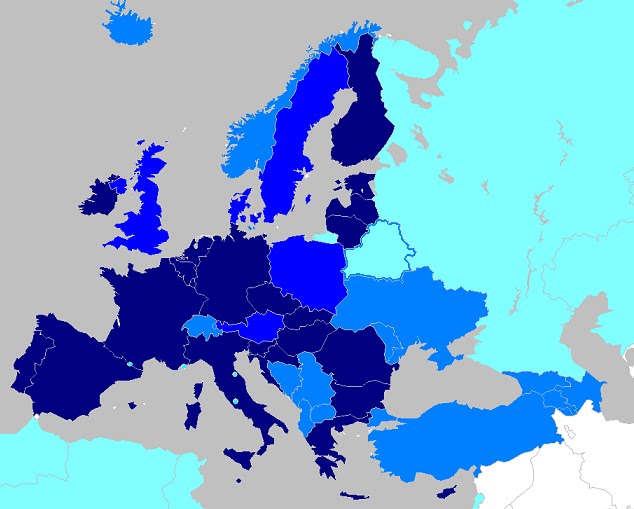
There would be nothing to stop the group of non-EU members here (to list, Iceland, Norway, Switzerland, Liechtenstein, Turkey, Ukraine, Georgia, Moldova, Serbia, Macedonia, Montenegro) to sit down and discuss common interests and possible future co-operation. This is admittedly just an idea and hasn't been fully thought through, but perhaps not all roads in Europe lead to Brussels (?).

Friday, October 21, 2011

2012 in Ukraine-walking the democratic tightrope?

In defining Ukraine's future, the Euro 2012 football championship looks like being a sideshow compared to the parliamentary elections which, if they go the President's way, may clear the political field for years to come. At the heart of this is the coming change to Ukraine's electoral system.

The proposal is for a mixed system, with half the deputies elected by party list and the other half by constituency mandate. Just like in Germany then, so that's all fine, or so the argument will go, rather like when people explain away post-Soviet autocracies as 'like the presidential system in France', conveniently failing to mention the liberal media environment, the French fondness for and tolerance of protests, strikes and direct action and, not least, democratic nuances such as the genuine Presidential Primaries currently taking place in the French Socialist Party. The assertions are short and snappy, but the counter-arguments require explanation.

The desire is, it must be believed, for a consolidated power vertical rivalling anything else in the post-Soviet space, but Yanukovych is walking a tightrope to a much greater extent than his counterparts in Russia or Belarus. Russia, because it does not aspire to any form of western integration (WTO membership aside). Russia's elections are carefully engineered through restrictions on registration of opposition candidates, high thresholds for entering parliament etc. In Belarus they just make it up, despite it being fairly certain in the past that Lukashenka could have won fair and square. Perhaps his currently plummeting popularity there suggests that, from his point of view, he made the right choice.

The difference with Ukraine is that its semi-democratic credentials are based on the sequence of free and fair elections, two parliamentary and one presidential, which took place under Yushchenko's much-despised stewarship. That means that Ukraine now has more to lose from western partners. We know they can do better. Therefore the maintaining of the Party of Regions' grip on power requires an approach certainly more subtle than in Belarus, and perhaps more ingenious than that in Russia. Yanukovych will never be able to pull off the United Russia trick, which relies on Putin's personal popularity.

The new law does not look like it will be the one to restore Ukraine's 'free' status that Freedom House stripped it of last year. To get into the nitty-gritty, the new law would take us back more or less to the system that was used in 1998 and 2002. The electoral constituencies will be formed just 90 days ahead of the elections. Were this knowledge, heaven forbid, to be available to the powers that be in advance of that date, they would be able to steal a march on the opposition in terms of strategic planning. The election commissions would be formed of the parties in power, so the Party of Regions and the Communists. Party lists will be able to be changed even on election day itself. Appeals will be impossible in practice because the deadline will have expired while the documents are still in the post. And so the list goes on...

But it may not be these technical aspects that lead to a democratic malfunction in 2012, but rather two important cultural aspects. Firstly, that whether or not the President is trying to steer Ukraine down the European path, much of his support base has clearly taken his coming to power as a return to the 'good old days'. That means back to the days when ballot boxes are loaded into trucks or thrown in rivers. I'm not sure Ukraine's leadership will be able to prevent widespread abuses even if it wished to, because the prevailing culture is now the pervasively undemocratic post-Soviet one. There's no real understanding in those circles of the value and importance of respecting the rules.

The second cultural aspect rests with the electorate. It has been found that, particularly amongst the young, there is a despondency about the whole exercise and a willingness to sell their vote for 100-200 dollars. It has also been noted by researchers that trust in Ukraine's judiciary has plummeted over the last year and a half. There is little hope of successfully challenging any violations. Having said that, interviews with the public have thrown up some quite reasonable suggestions-that deputies who do not attend parliament should be fired or not paid, that each voter should have a stamp confirming that they've already voted put in their internal passport (the Sovietesque Ukrainian national identity document) to prevent multiple-voting and the banning of deputies elected on lists from crossing the house. But in the end, whilst both the general population and the elites have plenty to say on what should be amended in the new law, there is clearly a fundamental disconnect between any of these people and the decision-makers, who have probably already decided what they want.

The elections will almost certainly take place in the restricted media climate that has come to exist in recent times. And in any case, following the elections it's difficult to say what the point will have been, given the deterioration of procedural standards in the Verkhovna Rada, the 'piano-players' voting for absent deputies, use of physical violence, blocking of the rostrum by the opposition etc. And presumably if the result is not quite the desired one, the Constitutional Court will allow a few 'tushki' to cross the house and make up the numbers.

Events may anyhow overtake things. Relations with the west are deteriorating rapidly and, in the worst case scenario, the incentives for democratic good behaviour may have all but evaporated by then. In any case, the EU is, for all its faults, a community of shared values, and if these values are not in evidence in Ukraine, one could say, what is there to discuss?

The author attended Civic Discussion of Parliamentary Election Law of Ukraine on 19th October 2011 http://kyivweekly.com.ua/accent/news/2011/10/13/144855.html

Friday, October 14, 2011

Is this what it takes to get Europe's attention back on the east?


The sight of the forlorn Tymoshenko on newspaper front pages across the world has arguably given Ukraine the most exposure that it's had since the Orange Revolution. At EU level, it was telling that a europarl news item on a European Parliament plenary session which would have read 'MEPs to debate Middle East uprisings with Catherine Ashton' now read 'MEPs to debate Middle East uprisings and sentencing of Ukrainian opposition leader with Catherine Ashton'. Is this what it takes to get the EU's attention on to the problems on the eastern half of its own continent, rather than on Europe's external periphery. The willingness to prioritise emerging democracy in the southern neighbourhood over its survival in the eastern neighbourhood might have proceeded undeterred were it not for this very serious wake-up call.

Even more than Europe's diplomatic shortcomings, the Ukrainian President now seems to have come up with a spectacular inverted version of the famed 'yes man' Kuchma diplomatic policy, having managed to disenfranchise not only the Unites States and European Union, but Russia as well. Indeed, that the conviction centres on a gas deal countersigned by Russia's all-powerful de facto President is a prickly point, and it's very possible that the Russian Prime Minister considers it a personal slight (Putin has apparently said that he doesn't like Yanukovych, add to the well known fact that he 'personally detests' the Belarusian President Aleksandr Lukashenka-politics in this part of the world is always personal).

The world's newspapers have perhaps got the wrong idea. Tymoshenko is no Aung San Suu Kyi, even if the Ukrainian judiciary risks turning her into one in the eyes of many. It has been more soberly pointed out in some quarters that the 2009 gas deal did contain some quite serious violations. But these violations were made at a time of extraordinary pressure on the Prime Minister. Both Russia and EU states seem to be rather forgetting their roles in what transpired that January as a result of Russia shutting off the gas taps. They are also largely based on Soviet era laws, as is the precedent for the curious practice of a personal fine levied for a loss to the state budget. After all, nobody has claimed that Tymoshenko has personally helped herself to funds from the gas deal. What even happened to the Kyoto money we were talking about when she was first charged?

It's also in a sense not the point. Tymoshenko's party is the only genuine opposition left in Ukraine. Commentator Taras Kuzio claims that every other party feeds dierctly or indirectly into the Party of Regions power structure. Like Khodorkovsky in Russia, dismissed by many as 'no angel', the most obvious casualty is that of political pluralism in the state. It's doubtful that Tymoshenko has really been put away for technical reasons. Amongst various theories, one suggestion was simply that the President is sick of her endless ex-con jibes.

The news that further charges are going to be leveled against Tymoshenko is hardly going to help curry favour abroad. The new charges, of direct personal enrichment, are perhaps more to the point, but I would steer clear of that one, at risk of creating a precedent for looking into the ill-gotten gains of one's predecessor's personal enrichment following their fall from power.

So now we see a diplomatic squeeze on Ukraine from outside, but at the same time a domestic squeeze on Ukraine's population. New currency exchange laws and bans on loans in foreign currency are a case in point. Indeed, the new currency exchange rules have lead to currency exchange booths in central Kiev turning away foreign customers altogether. With Kiev's newly-renovated Olympysky Stadium set to host a friendly between Ukraine and Germany in November, one has to wonder how any Germany fans brave enough to make the trip are going to get on. Most likely, we'll see a facade similar to the one Russia put on when it hosted the 2008 Champions' League final, where the visa requirement was temporarily dropped to prevent the embarrassment of 70000 Brits queueing for Russian visas, and the notorious Russian police were suddenly immaculately-behaved, for 48 hours or so. It will be a great shame if Euro 2012 next summer turns out to be a similar cosmetic exercise rather than a lever for change and a chance for the country to adopt European norms in many areas. It has been suggested that the new currency rules are in fact a data-collecting exercise on the country's citizens which will soon be complete, for some unknown purpose.

On the subject of sport, an interesting aspect of the Tymoshenko detention is that it leaves a vacancy for opposition figurehead that may be filled by one of Ukraine's most popular public figures, boxer Vitali Klitschko, who has been boosting his media profile of late. Although he did not previously succeed in two attempts for the Kiev mayoral office, he has the distinct advantage that, unlike almost all the alternative figures in Ukrainian politics, Klitschko did not get to his present position through corruption. His time living in Germany also gives him a different perspective on how the country should be run. There are big question marks about how politically able he is, and whether he can overcome a fair amount of public scepticism about his ambitions, but if he surrounded himself with the right people he would certainly do no worse than the current incumbent, and might be the one to finally knock some heads together!

Tuesday, May 31, 2011

EU-Ukraine trade deal a long haul but not a dead end

Ratification of the EU-Ukraine trade deal may drag on a while, but it beats the dead end of the customs union.

Ukrainian politicians put their foreign counterparts to shame when it comes to empty or over-optimistic promises, but there appears to be something in the current administration's assessment that the EU-Ukraine Deep and Comprehensive Free Trade Area' DCFTA could be thrashed out by the end of the year, with EU sources admitting that real progress is being made. So goods will be sailing through a customs free Polish-Ukrainian border by the time of the Euro 2012 football championships? Whoa there, not so fast!

Even if Ukraine makes good on its pledge to satisfy all the terms by the end of this year, the agreement will still have to go through a lengthy ratification process, through the Verkhovna Rada, the European Parliament and finally, the potentially sticky wicket, the European Council of the member states themselves. That could mean the process being spun out into next year, possibly ending up on the back burner for a time whilst the elections to the European Parliament are being fought. If the wheels do keep moving, an optimistic forecast is that the agreement might come into force in 2015. With the various 10 year moratoriums on certain issues, the full extent of the agreement could then finally be realised by 2025.

So, why would Ukraine wait such a long time for the EU when the customs union with Russia, Kazakhstan and Belarus is already ready and waiting? Well, current events in Belarus give a good pointer there. The shortages of foreign currency that have fueled the crisis there owe a lot to the start of the customs union earlier this year. Belarus had to increase import tariffs on cars from the west as part of the agreement and, rather than wait for Ladas from friendly Russia to flood the Belarusian market, Belarusians rushed to get hold of cars from the west before the tariff went up, and that meant the need for foreign currency, which quickly turned into the chaos we see today with speculators from Ukraine and Russia flooding over the border to make a killing selling currency at vastly inflated rates. Enter now Russia itself with offers to buy up Belarus's key assets to dig them out of trouble, and it could be goodbye to pipelines and refineries, and a major handicap in the Titoist east-west balancing game at which Lukashenka has excelled himself in the past. And if Belarus wants to change the tariffs that started this whole mess? Well, between themselves and Kazakhstan they wouldn't be able to muster a controlling vote, as 54% of votes apparently belong to Russia, and incidentally, a lot of the revenue from the tariffs won't even go to Belarus, but to Russia. Rather than Ukraine looking to join, surely Belarus and Kazakhstan should be running for the exit door as fast as they can!

For Ukraine, there is plenty of real work to do, and not only on DCFTA. June 2011 was Yanukovych's proclaimed date for ticking the various boxes in the move towards visa free travel to the Schengen area for Ukrainians. Yet we are now told September 2011. The chief sticking point is the required introduction of biometric passports for Ukrainians. As so often in Ukraine, parochial self-interest threatens the greater good, in the form of a private company represented in the Verkhovna Rada which apparently produces the country's passports, and which is no doubt holding out for a greed-fueled windfall from the process. And we can expect such instances to remain the norm for the foreseeable future. Add to this the inability of Ukraine to see that a mere €150m of EU money is properly accounted for, and you would forgive those who remain sceptical.

Until the Ukrainians have to put pen to paper on the trade deal, we may see, as has been suggested in some quarters, a last minute rush to get hold of the country's assets via more of the country's ubiquitous dodgy privatisations, after which there is an idea that people, at least in theory, will start playing by the rules. Once signed, the emphasis will then be on compliance, and that could turn out to be the biggest hurdle of all. If in 2025 things have been ticking along well, and the EU has moved on and stabilised from its present traumas, they may finally be willing to talk membership. If however a ratified free trade deal is not complied with, then Ukraine's European aspirations truly will founder on the rocks, with only itself to blame.

Thursday, May 19, 2011

Moscow Patriarch photoshops his way to popularity in Ukraine

More clutching at straws by the Russians

I wrote recently about the stumbling lack of progress Russia has had trying to sell it's customs union in Ukraine, against the opportunity to enter a deep free trade deal with the EU instead. I also mentioned the Moscow Patriarch's obsessive visits to Ukraine since his installation, far more frequent than those of his predecessor. Well it now seems the obsessiveness has reached new heights.

I was astounded to hear recently that, following his 9th May visit to Kharkiv, Patriarch Kirill's own website carried a photo of massed crowds in the city's Freedom Square which appeared to have been doctored. Compare the mass of worshipers in the first photo with the rather more subdued reception suggested by the second photo.


Unsurprisingly, the photo has since been removed from the official page. To my sensibilities, such an action by a church website would heap shame on any reputable christian organisation, but it perhaps tells us a lot about the real forces at work in the Moscow Patriarchate (?), and the importance of presentation in the current information war.

The fact is that most eastern orthodox Ukrainians take little interest in these squabbles, and many attend both Moscow and Kiev Patriarchate churches without giving it much thought. The real Kharkiv picture suggests relative indifference to the Patriarch's visit, even in the Russian-speaking heartlands. Perhaps Ukraine is suffering from Kirill-fatigue?